


Threads of Truth - The Real Cost of Post-Consumer Recycled Cotton: Issue One


Executive Summary:
This report is the first in a three-part series by the Denim Deal, aimed at addressing the costs, challenges, and misconceptions surrounding post-consumer recycled (POCR) cotton in the denim industry. Drawing on literature reviews, market analysis, and expert surveys, the series explores how POCR cotton can support a more sustainable and circular textile economy.
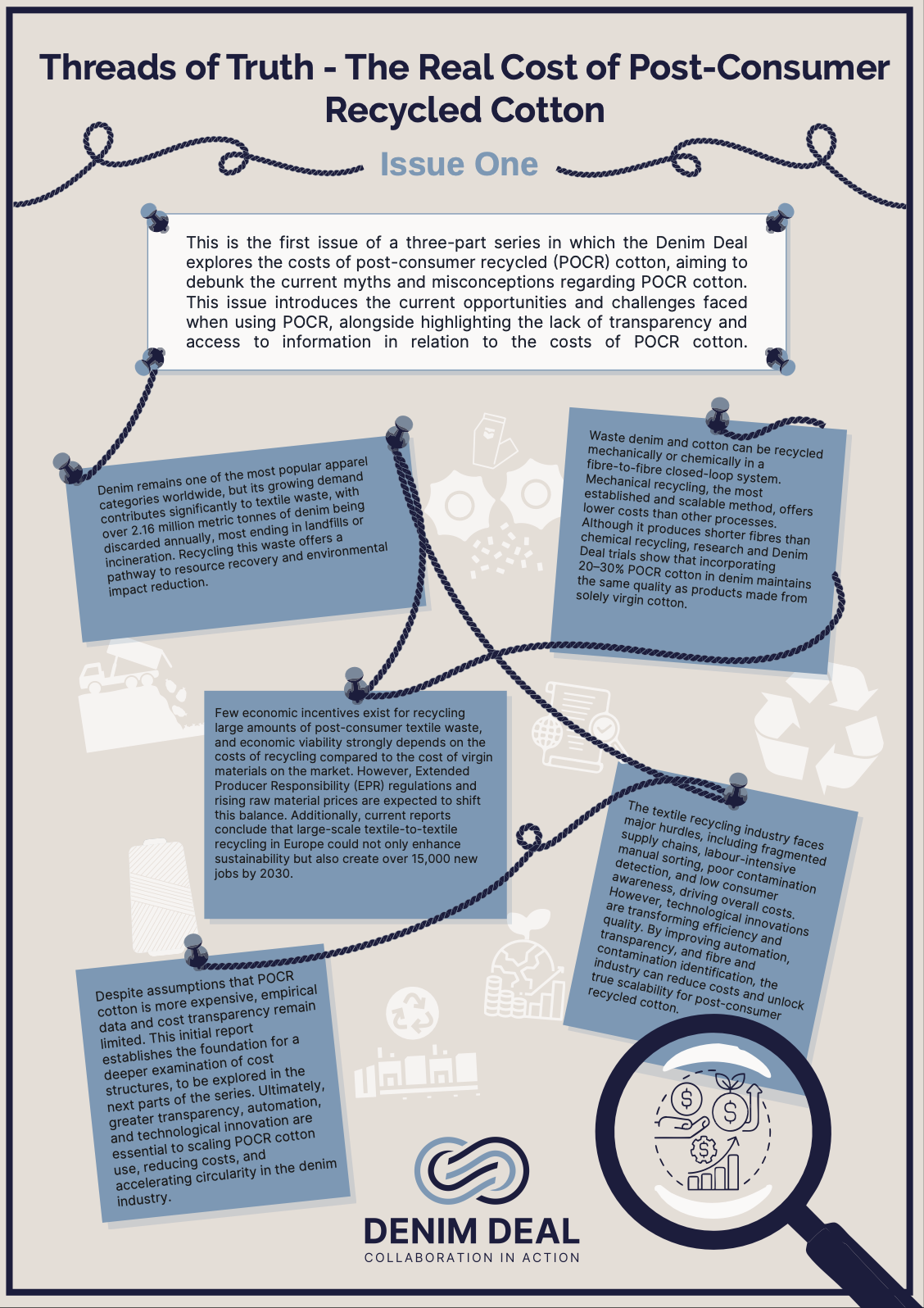
Denim remains one of the most popular apparel categories worldwide, but its growing demand contributes significantly to textile waste, with over 2.16 million metric tonnes of denim being discarded annually, most ending in landfills or incineration. Recycling this waste offers a pathway to resource recovery and environmental impact reduction.
The report focuses primarily on mechanical recycling, the most established and scalable method for denim waste. Although mechanical recycling shortens fibre length and can lower yarn quality, research and industry trials show that denim containing 20–30% POCR cotton maintains quality comparable to virgin cotton.
Economic factors remain a key barrier. Recycled cotton currently struggles to compete with virgin materials, and limited transparency around costs fuel its misconceptions. However, upcoming Extended Producer Responsibility (EPR) legislation and rising raw material prices are expected to make recycling more economically viable. Studies also suggest that large-scale textile-to-textile recycling in Europe could create over 15,000 jobs by 2030, underscoring both the sustainability and economic potential of this transition.
Critical challenges include fragmented supply chains, inefficient manual sorting, fibre and contamination identification and lack of consumer awareness. Manual sorting alone accounts for 30% of recycling costs and presents ineffective contamination identification of waste textiles. Innovations such as automated sorting (e.g., Valvan’s NIR-based systems), lubricant pretreatments, and Smart Creel weaving technology are improving the overall processing and quality consistency.
g circularity in the denim industry.empirical data and cost transparency remain limited. This initial report establishes the foundation for a deeper examination of cost structures, to be explored in the next parts of the series. Ultimately, greater transparency, automation, and technological innovation are essential to scaling POCR cotton use, reducing costs, and accelerating circularity in the denim industry.
Threads of Truth - The Real Cost of Post-Consumer Recycled Cotton: Issue One
This is the first issue of a three-part series in which the Denim Deal explores the costs of post-consumer recycled (POCR) cotton, aiming to debunk the current myths and misconceptions regarding POCR cotton. Through literature, market research, and a survey amongst industry experts, three reports have been created to help highlight the advantages, challenges and future prospects of POCR cotton within the denim industry. This report introduces the current opportunities and challenges faced when using POCR, alongside highlighting the lack of transparency and access to information in relation to the costs of POCR cotton.
Denim is one of the most commonly worn items of apparel and has become an essential part of past, present and future fashion. Worn globally by individuals of all ages and genders and suitable for a broad range of seasons and events, it is an integral clothing item in nearly everyone’s wardrobe (1). However, with the consistent and growing popularity of denim, the industry faces consequences. Nearly 2.16 million metric tonnes of denim waste are generated annually, with most ending up in landfills or incineration (2–5). This results in the complete depletion of their contents and wasting what could be a valuable resource (6). Therefore, measures need to be taken to deal with the waste issues and ensure the reuse of valuable material resources at the end of their life.
Waste denim and cotton can be mechanically or chemically recycled in a fibre-to-fibre closed-loop system (7). Mechanical recycling is the most established recycling process, with lower costs than chemical or bio-based processes and will be the main focus within this three-part series. In addition, it is currently the most scalable process, which is necessary for an industry as large as denim (8,9). Fibre quality is often determined by its length, fineness and evenness (10). When mechanically recycling textile waste, the material is cut, shredded and opened up into fibres. It has a low to medium output due to the fibre length shortening and the increase in short fibre content, which can pose further challenges when spinning the fibres into yarns. Additional virgin or alternative materials are often needed to make the fibres spinnable (11–13). Although the output of mechanically recycled fibres is lower than that of chemically recycled fibres, it has been proven that using 20-30% of POCR content in denim does not impact the end quality. Both academic research studies and work done by the Denim Deal and their members have proven this by incorporating a minimum of 20% POCR cotton in their denim products, resulting in equal quality compared to products made from solely virgin cotton (5,14,15).
Few economic incentives exist for recycling large amounts of post-consumer textile waste, and economic viability strongly depends on the costs of recycling compared to the cost of virgin materials on the market. Regulations such as the Extended Producer Responsibility (EPR) can give the needed incentives for recycling. The EPR regulation will make producers finally responsible for treating their waste streams, including the end-of-life of their products. The imbalance between the costs of recycling compared to virgin materials will likely shift in the near future due to upcoming legislation and increasing prices on both natural and fossil-based materials (10).
Current reports conclude that large-scale textile-to-textile recycling in Europe holds a key to making the textile industry more sustainable and that such an industry could be economically beneficial, generating over 15,000 new jobs within the EU between now and 2030 (13). Supply chain capabilities hold one of the main keys to enhancing sustainability as well as economic viability in the emerging textile-to-textile recycling industry. Such capabilities are needed to ensure cost efficiency and the necessary infrastructure in conjunction with waste collection and sorting. The availability of feedstock for recycling plays a key role as a success factor, emphasising the necessity for proper collection and sorting of textile waste. Key stakeholders within textile recycling are more fragmented, resulting in complexities and challenges related to transparency. Additionally, from a consumer’s perspective, the benefits of textile recycling can be unclear. Therefore, many households are generally less educated in how to deal with textile waste compared to other waste streams, such as paper or plastic (13). This can then contribute to a large amount of textile waste ending up in landfill instead of textile recycling streams, impacting consistent feedstock streams (6). This underscores the need to raise consumer awareness about textile waste and proper end-of-life disposal, ensuring materials can effectively be used as textile recycling feedstock.
Next to that, the sorting of post-consumer textiles relies heavily on manual operation, which is inefficient, labour-intensive and poses risks to workers (20). The labour costs account for 30% of the entire textile recycling costs. Moreover, the sorting process also faces many bottlenecks, such as the identification of waste components, fibre composition and other characteristics such as finishes, contaminations or multiple textile layers. Due to uncertainties and a lack of transparency regarding time, quality, contamination, origin of production and end-of-life, sorting and recycling face further challenges, increasing the overall cost of the process (21–23). Therefore, by improving transparency, automated processing, accurate fibre and contamination identification, the process will be made more efficient and will effectively reduce costs.
Developments and technological advancements have been made in improving the overall fibre and yarn quality using POCR cotton by optimising the sorting, mechanical recycling, spinning and weaving processes (10,16). Technological advancements that aid the mechanical recycling process include the innovative automated sorting and cutting machines developed by Valvan. These machines employ two types of near-infrared spectroscopy (NIR) from different angles to ensure better identification of material composition. In addition, the technology lets users specify unwanted materials such as hard accessories or thick seams, which are then identified, cut and filtered out, ensuring the best possible material output for recycling (17). Lindström et al. utilised polyethylene glycol (PEG) based lubricants as pretreatment agents for mechanical recycling. Thus, reducing interfibre cohesion and aiding the overall disassembly and tearing of the textiles (11). Another key innovation that can help with the weaving of POCR cotton is the Smart Creel by Vanderwiele. The Smart Creel can individually control the tension of each warp thread and reduce the amount of material waste in production. Moreover, an example of a company utilising this technology with POCR materials in Enshcede Textielstad (18,19). Through such technological advancements and by incorporating post-consumer waste in denim production, positive contributions are being made in dealing with the waste and raw material resource crisis. However, it is important to note that further research and development are necessary in identifying contaminations such as finishes. This is vital in ensuring higher quality and cleaner feedstock for recycling, while also contributing to cost reductions.
While current literature and common speculation suggest that POCR cotton is more expensive than virgin cotton, many sources make the claim without providing clear evidence or transparent figures to support it (9,24). The following part of this series will investigate the costs of virgin cotton compared to those of POCR cotton in more depth, questioning the validity of cost assumptions, as well as present the results of a survey conducted with industry experts to attempt to debunk the costs of POCR cotton.
References
1. Rahaman MdT, Shikder AAR, Al Mamun MdA. Environmentally sustainable color fading approaches of denim fabric using alternative garments dry process: An insight into chromatic parameters and physical properties. J Open Innov Technol Mark Complex [Internet]. 2024 Dec [cited 2024 Nov 28];10(4):100435. Available from: https://linkinghub.elsevier.com/retrieve/pii/S2199853124002294
2. Akı S, Candan C, Nergis B, Önder N. Understanding Denim Recycling: A Quantitative Study with Lifecycle Assessment Methodology. In 2020.
3. Ellen McArthur Foundation. A New Textiles Economy: Redesigning fashions Future [Internet]. 2017. Available from: www.ellenmacarthurfoundation.org
4. Haque ANMA, Naebe M. Sustainable biodegradable denim waste composites for potential single-use packaging. Sci Total Environ [Internet]. 2022 Feb [cited 2024 Nov 28];809:152239. Available from: https://linkinghub.elsevier.com/retrieve/pii/S0048969721073150
5. Rabbi KF, Banna BU, Mia R, Islam MdR, Hasan MdM. Utilization of post-consumer waste for sustainable denim manufacturing. Case Stud Chem Environ Eng [Internet]. 2023 Dec [cited 2024 Nov 29];8:100415. Available from: https://linkinghub.elsevier.com/retrieve/pii/S2666016423001202
6. Cundubey FS, Azgin ST. Comparative life cycle assessment of denim manufacturing: Evaluating conventional vs. recycled cotton in the context of renewable energy. J Clean Prod [Internet]. 2024 Jan [cited 2025 Mar 7];434:140117. Available from: https://linkinghub.elsevier.com/retrieve/pii/S0959652623042750
7. Vermeyen V, Alaerts L, Worrell E, Van Acker K. Threads untangled: Regional mapping of post-consumer textile management. Clean Waste Syst [Internet]. 2024 Dec [cited 2025 Apr 15];9:100181. Available from: https://linkinghub.elsevier.com/retrieve/pii/S277291252400054X
8. Ribul M, Lanot A, Tommencioni Pisapia C, Purnell P, McQueen-Mason SJ, Baurley S. Mechanical, chemical, biological: Moving towards closed-loop bio-based recycling in a circular economy of sustainable textiles. J Clean Prod [Internet]. 2021 Dec [cited 2025 Mar 10];326:129325. Available from: https://linkinghub.elsevier.com/retrieve/pii/S0959652621035101
9. Lu L, Fan W, Meng X, Xue L, Ge S, Wang C, et al. Current recycling strategies and high-value utilization of waste cotton. Sci Total Environ [Internet]. 2023 Jan [cited 2025 Aug 12];856:158798. Available from: https://linkinghub.elsevier.com/retrieve/pii/S0048969722058971
10. Oelerich J, Mahy JWG. Closed-loop postconsumer textile recycling. Sustain Innov Text Ind. 2024;
11. Lindström K, Van Der Holst F, Berglin L, Persson A, Kadi N. Mechanical textile recycling efficiency: Sample configuration, treatment effects and fibre opening assessment. Results Eng [Internet]. 2024 Dec [cited 2024 Dec 8];24:103252. Available from: https://linkinghub.elsevier.com/retrieve/pii/S2590123024015068
12. Utebay B, Celik P, Cay A. Valorization of fabric wastes through production of recycled cotton yarns by compact ring and open-end rotor spinning. J Clean Prod [Internet]. 2023 July [cited 2024 Dec 8];409:137135. Available from: https://linkinghub.elsevier.com/retrieve/pii/S0959652623012933
13. Sandberg E, Pal R. Exploring supply chain capabilities in textile-to-textile recycling – A European interview study. Clean Logist Supply Chain [Internet]. 2024 June [cited 2025 Apr 14];11:100152. Available from: https://linkinghub.elsevier.com/retrieve/pii/S2772390924000143
14. Arafat Y, Uddin AJ. Recycled fibers from pre- and post-consumer textile waste as blend constituents in manufacturing 100% cotton yarns in ring spinning: A sustainable and eco-friendly approach. Heliyon [Internet]. 2022 Nov [cited 2025 Aug 12];8(11):e11275. Available from: https://linkinghub.elsevier.com/retrieve/pii/S2405844022025634
15. Baloyi RB, Gbadeyan OJ, Sithole B, Chunilall V. Recent advances in recycling technologies for waste textile fabrics: a review. Text Res J [Internet]. 2024 Feb [cited 2025 Sept 3];94(3–4):508–29. Available from: https://journals.sagepub.com/doi/10.1177/00405175231210239
16. Shahid MA, Hossain MT, Habib MA, Islam S, Sharna K, Hossain I, et al. Prospects and challenges of recycling and reusing post-consumer garments: A review. Clean Eng Technol [Internet]. 2024 Apr [cited 2025 Aug 12];19:100744. Available from: https://linkinghub.elsevier.com/retrieve/pii/S2666790824000247
17. Cura K, Rintala N, Kamppuri T, Saarimäki E, Heikkilä P. Textile Recognition and Sorting for Recycling at an Automated Line Using Near Infrared Spectroscopy. Recycling [Internet]. 2021 Feb 8 [cited 2025 July 29];6(1):11. Available from: https://www.mdpi.com/2313-4321/6/1/11
18. Vandewiele. Vandewiele Weaving. 2025 [cited 2025 Sept 8]. MAX91. Available from: https://vandewiele-weaving.com/machines/max91
19. Enshcede Textielstad. About us [Internet]. Enschede Textielstad. [cited 2025 Sept 8]. Available from: https://en.enschedetextielstad.nl/about-us/
20. Tian R, Lv Z, Fan Y, Wang T, Sun M, Xu Z. Qualitative classification of waste garments for textile recycling based on machine vision and attention mechanisms. Waste Manag [Internet]. 2024 June [cited 2025 July 29];183:74–86. Available from: https://linkinghub.elsevier.com/retrieve/pii/S0956053X24002629
al Intelligence for Pattern Recognition of Textile Sorting and Recycling for Circular Economy. Procedia Comput Sci [Internet]. 2025 [cited 2025 July 29];253:346–56. Available from: https://linkinghub.elsevier.com/retrieve/pii/S187705092500105X
22. Du W, Zheng J, Li W, Liu Z, Wang H, Han X. Efficient Recognition and Automatic Sorting Technology of Waste Textiles Based on Online Near infrared Spectroscopy and Convolutional Neural Network. Resour Conserv Recycl [Internet]. 2022 May [cited 2025 Apr 29];180:106157. Available from: https://linkinghub.elsevier.com/retrieve/pii/S0921344922000052
23. Scholz M, Valilai OF. Integrating Chipless RFID Technology to Provide Seamless Data Interoperability for Textile Industry Circularity. Procedia Comput Sci [Internet]. 2025 Jan 1 [cited 2025 Apr 30];253:393–402. Available from: https://www.sciencedirect.com/science/article/pii/S1877050925001097
24. Leal Filho W, Ellams D, Han S, Tyler D, Boiten VJ, Paço A, et al. A review of the socio-economic advantages of textile recycling. J Clean Prod [Internet]. 2019 May [cited 2025 Aug 19];218:10–20. Available from: https://linkinghub.elsevier.com/retrieve/pii/S0959652619302306
25. Voora V, Bermudez S, Farrell, JJ, Larrea, C, Luna E. Cotton prices and sustainability. International Institution for Sustainable Development; 2023 Jan. (SUSTAINABLE COMMODITIES MARKETPLACE SERIES).
26. Textile Exchange. Materials Market Report. 2024 Sept.
Related News

Threads of Truth - The Real Cost of Post-Consumer Recycled Cotton: Issue One
Denim is a global fashion staple, but behind every pair of jeans lies a growing mountain of waste. Each year, over two million tonnes of denim end up in landfills, wasting valuable cotton that could be given a second life. This first report in the Denim Deal’s three-part series pulls back the curtain on post-consumer recycled (POCR) cotton, exposing the myths surrounding its cost and uncovering the untapped potential of circular denim. Through insights from industry experts, market research, and new technological breakthroughs, it reveals how recycled cotton could reshape the future of denim—making sustainability not just a choice, but the industry’s next revolution.
Complexity and Overwhelm: Denim’s Traceability Challenge
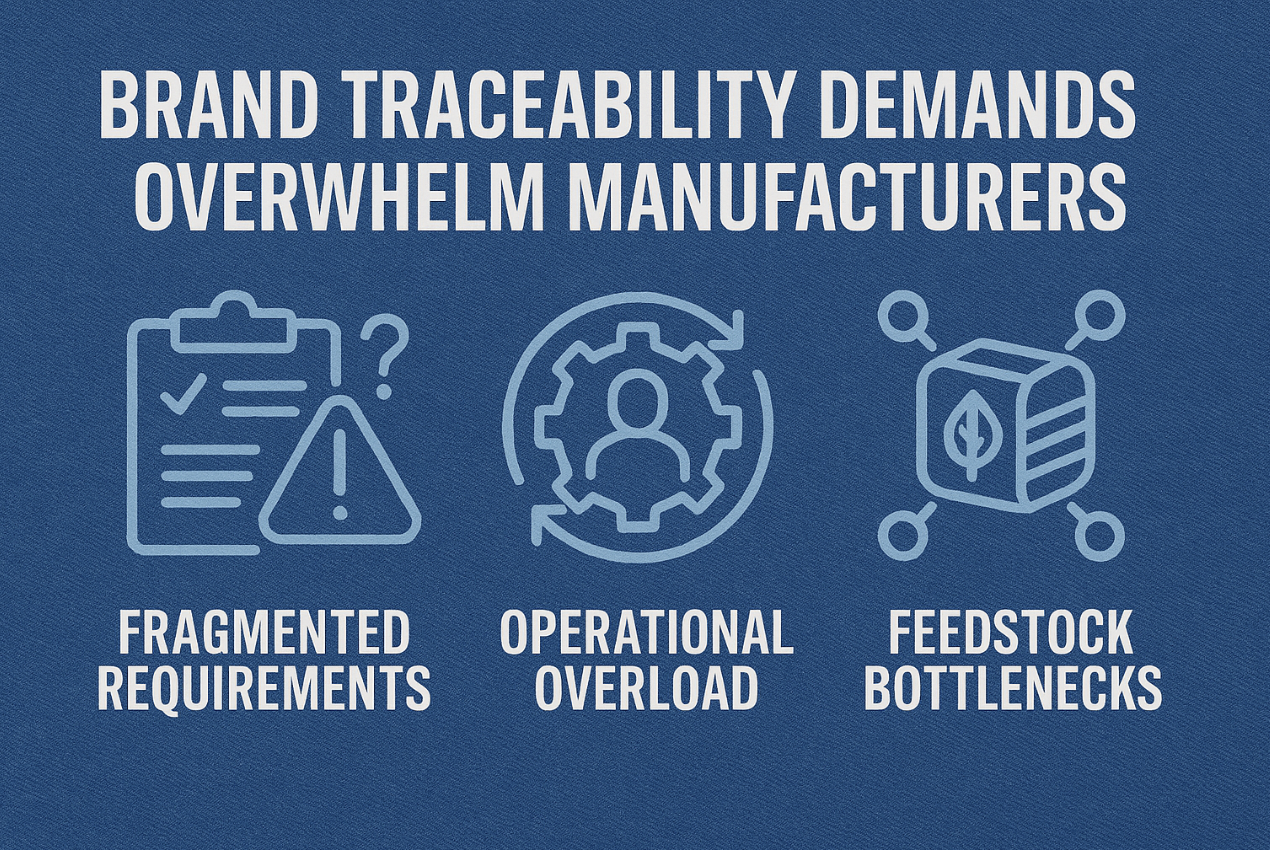
Traceability is becoming a make-or-break issue for fashion, with EU regulations and consumer demand pushing brands to act. For denim manufacturers, especially those using post-consumer recycled cotton, the real challenge is fragmented standards, multiple portals, and rising compliance costs. The Denim Deal calls for harmonized definitions, shared digital infrastructure, and stronger textile collection systems to ease this burden. Without collaboration, traceability risks slowing down circular innovation instead of enabling it

Navigating the New Tariff Landscape: How Denim Brands and Suppliers Can Thrive Amid US Trade Shifts
Become a partner
Join a network of denim industry leaders committed to scaling circularity. Gain access to collaboration opportunities, industry expertise and the tools to drive real change.
Become a member
Join a network of denim industry leaders committed to scaling circularity. Gain access to collaboration opportunities, industry expertise and the tools to drive real change.




